
The Turnaround: Repositioning Legacy Brands in the Japanese Market
Transformation is hard anywhere. It is harder in a Challenger brand and even harder in Japan, where it’s a battle against the 'status quo'.
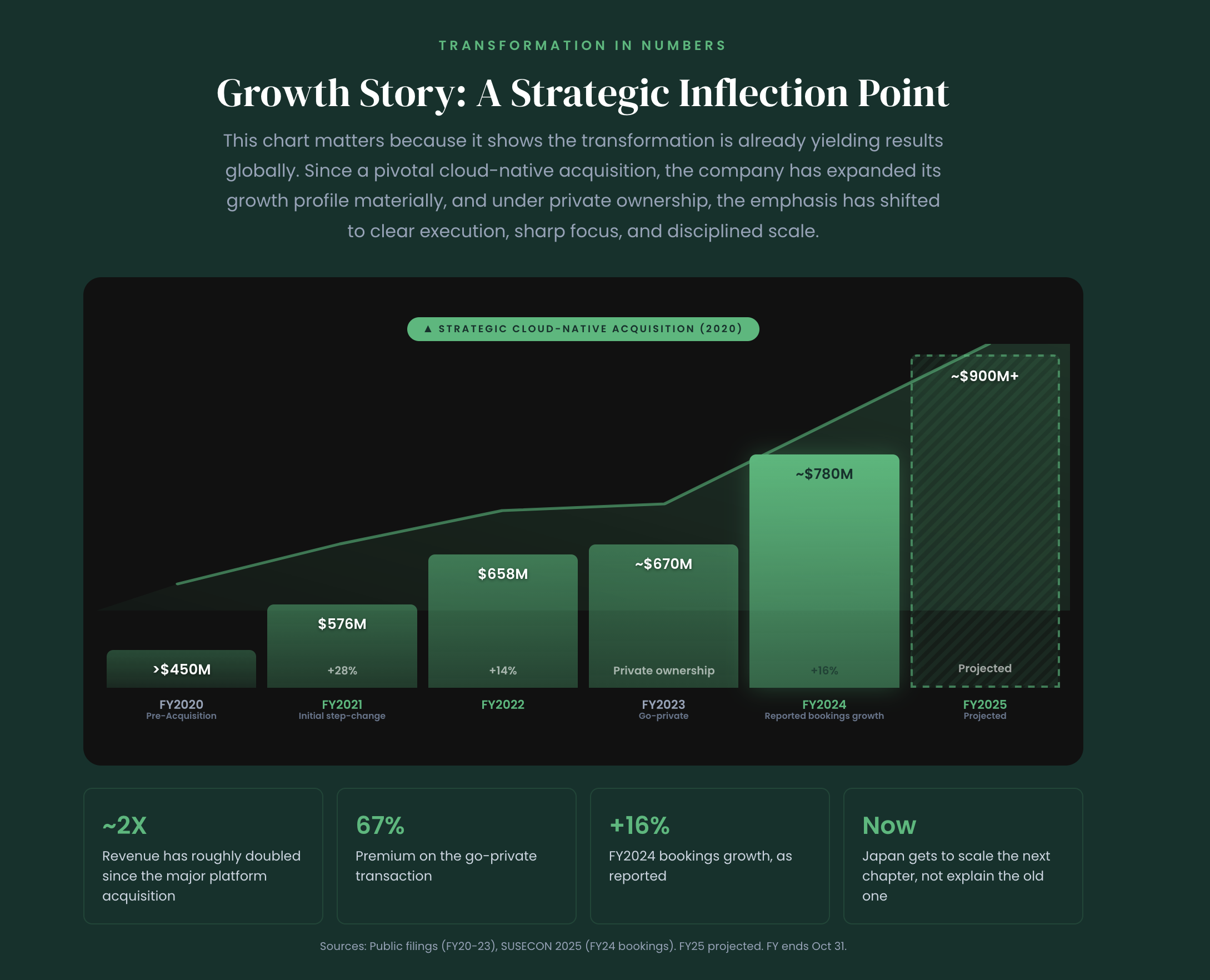
Image Above: One of the images our AI page builder generated to promote our client’s story.
The most demanding leadership roles in enterprise tech are rarely in early-stage startups. They sit inside established brands facing a “quiet” turnaround — where the product is proven, but the local market identity has gone static.
In the landscape of enterprise technology, the most demanding leadership roles are rarely found in early-stage startups. Instead, they exist within established brands facing the challenge of a “quiet” turnaround.
This scenario occurs when a company has a stable customer base, a proven product, and global technical strength, but its local market identity has become static. In Japan, where long-term reputation is paramount, being categorized as a “legacy” vendor can be a significant hurdle. When a brand is perceived through a narrow lens — such as being solely a provider of infrastructure or traditional operating systems — it affects the company’s ability to attract top-tier talent, secure strategic partnerships, and engage with modern customer priorities.
To change this trajectory, a leader must do more than manage revenue; they must rebuild the company’s narrative from the ground up.
The Evolution of the SUSE Narrative in Japan
For several years, the prevailing sentiment in the Japanese market placed SUSE in a specific category: a reliable provider of Linux and infrastructure for an aging customer base. While this ignored the company’s global innovations, perception often dictates market reality.
Recently, however, SUSE Japan has begun to shift this narrative by focusing on a more comprehensive value proposition. The company is no longer just a Linux provider; it is positioning itself at the center of open infrastructure, multi-cloud control, and digital sovereignty. Several key indicators suggest this repositioning is gaining genuine traction.
Strategic AI Integration: The announcement of the SUSE AI Factory with NVIDIA addresses a specific enterprise need. Rather than promoting generic AI, SUSE focuses on “AI with control” — providing the security, governance, and infrastructure required by pragmatic Japanese enterprises.
A Focus on Digital Sovereignty: Research shows that while 98% of enterprises prioritize digital sovereignty, only 52% feel they are successfully achieving it. In Japan, 57% of respondents now view this as a strategic priority, aligning perfectly with SUSE’s mission to provide modernization without the risk of vendor lock-in.
High-Stakes Validation (Mizuho Bank): The recognition of Mizuho Bank at the 2026 SUSE Customer Awards serves as a powerful proof point. By migrating over 200 legacy servers to SUSE Multi-Linux Support, the bank reduced costs by more than 10 billion yen and redirected those funds toward AI development. This is not a pilot project; it is a fundamental modernization of a “megabank’s” core infrastructure.
Operational Momentum: The Japan team was recently recognized at the APAC Quarterly Business Review for meeting its targets and successfully delivering this new value proposition to the market. This indicates that the internal culture is aligning with the external strategy.
The Leader as a “Market Translator”
When a brand is in transition, the hiring challenge is immense. High-performing candidates are naturally risk-averse; they look for signs of HQ support, product competitiveness, and local market relevance. They do not want to spend their first year defending an outdated story.
In Japan, the Country Manager serves as the bridge between global strategy and local belief. They must possess a specific profile that includes enterprise credibility — the ability to gain the ear of C-suite executives at major institutions; builder energy — the willingness to actively participate in the “ground-up” work of changing market perceptions; strategic patience — the understanding that trust in Japan is built over time through consistent execution; and talent magnetism — the confidence to recruit top talent into a story that is still being proven.
Why the Search Strategy Matters
The success of SUSE Japan highlights why executive search must be context-driven. When SUSE was looking for a new Japan Country Manager, the requirement was not simply to find a person with a previous “Country Manager” title. The goal was to find a leader who understood the nuances of a repositioning effort.
TalentHub recognized that SUSE needed someone who could articulate a modern infrastructure story while respecting the company’s technical heritage. By focusing on the problem to be solved rather than just a list of qualifications, we were able to facilitate the appointment of Gen Watanabe.
The true measure of an executive hire is not the signing of the contract, but the results that follow: Can they change the market conversation? Can they attract a stronger caliber of talent? Can they turn a global vision into local, tangible proof?
The recent momentum at SUSE Japan — from the Mizuho success to the upcoming SUSE Summit Tokyo in July 2026 — suggests that the answer to these questions is a definitive “yes.”
Key Takeaways for APAC Leaders
The SUSE story offers a blueprint for other technology vendors in the region.
Before a business can scale in a complex market like Japan, it must first convince the market that it is relevant to the future, not just a relic of the past.
References & Further Reading
- SUSE AI Factory with NVIDIA: News Release
- SUSECON 2026 Announcements (Japan Summary): PR Times Japan
- SUSE Customer Awards 2026 (Mizuho Bank): Official Announcement
- Gen Watanabe on the Mizuho Modernization Project: LinkedIn Post
- Gen Watanabe on SUSE Japan Performance: LinkedIn Post
- SUSE Summit Tokyo 2026: Event Information
