
Hiring Channels in Japan
When hiring bilingual Go-To-Market (GTM) talent in Japan, the sourcing mix looks very different depending on whether you’re a domestic Japanese company or a foreign-affiliated (gaishikei) firm.
This chart tells the story clearly:
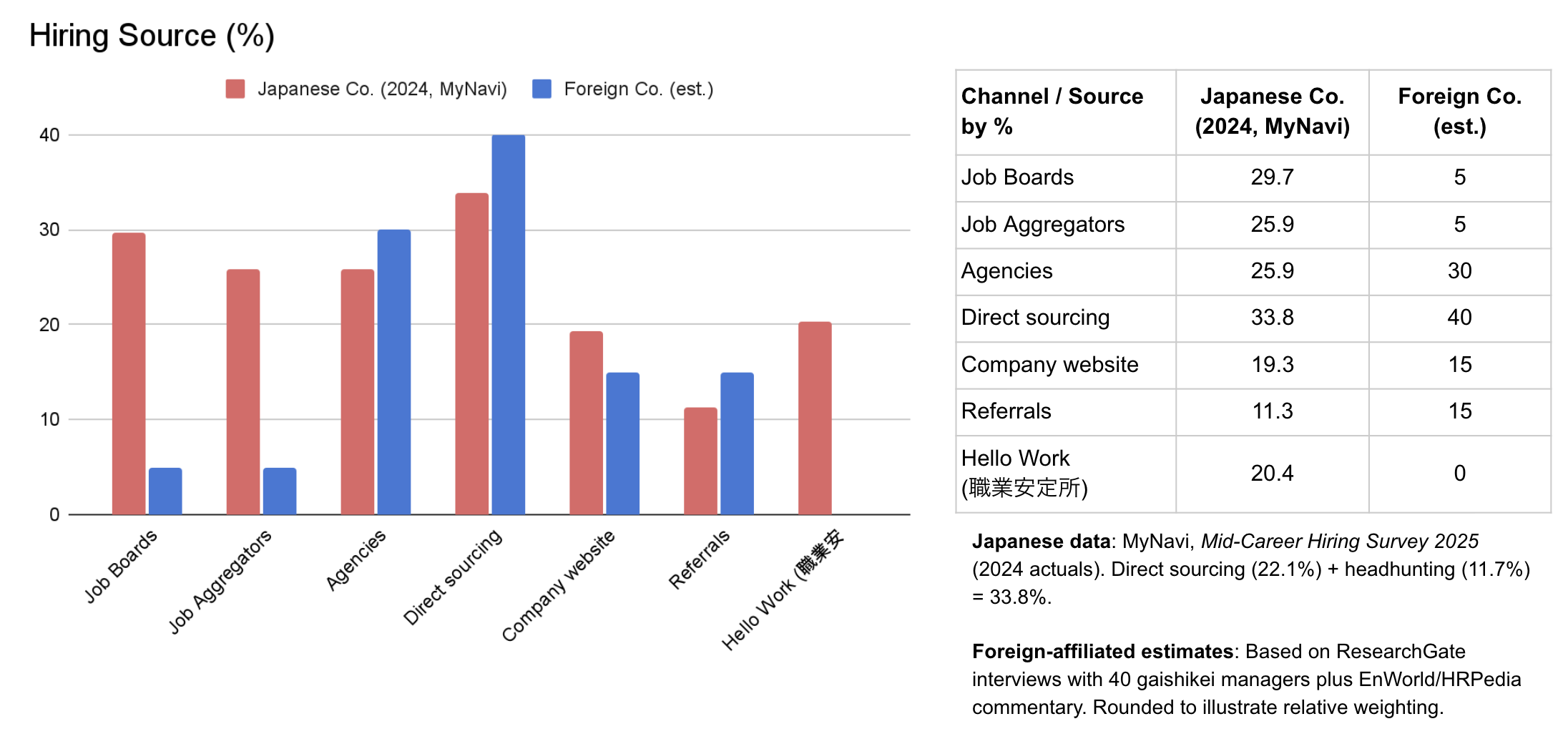
The Japanese corporate reality – job boards rule
According to MyNavi’s 2025 survey of mid-career hiring (2024 actuals), Japanese corporations lean heavily on inbound channels:
Job boards (29.7%) and job aggregators (25.9%) deliver the bulk of hires.
Recruitment agencies (25.9%) play a role but no more than boards.
Direct sourcing + headhunting (33.8%) is meaningful but still trails inbound overall.
Even Hello Work (20.4%), Japan’s public employment office, remains a major source.
In short, domestic firms hire by volume, optimising reach and inbound flow. This is a world where job boards dominate.
The foreign-affiliated reality – direct sourcing dominates
Interviews with 40 managers from foreign subsidiaries in Japan (plus EnWorld and HRPedia insights) reveal a very different mix:
Direct sourcing / scouting (~40%) is the single biggest source of hires.
Agencies (~30%) remain central, especially for startups and scale-ups building their first GTM teams.
Referrals (~15%) and company websites (~15%) supplement the funnel.
Job boards (~5%) and aggregators (~5%) are marginal, with limited bilingual candidate quality.
Hello Work (0%) is irrelevant.
In other words, gaishikei companies can’t rely on inbound. They must proactively hunt, headhunt, and network to secure the bilingual GTM talent they need.
Why the difference?
Domestic demand = volume. Japanese companies recruit at scale across functions and levels. Inbound channels fill roles quickly.
Foreign-affiliated = niche, bilingual GTM. These candidates rarely apply on job boards. They’re found via proactive outreach, agencies, or trusted referrals.
Stage of company matters.
Startups & scale-ups: lean heavily on agencies and headhunting.
Growth stage: build internal direct sourcing capacity.
Mature gaishikei: strengthen referrals and employer brand to reduce agency reliance.
Take-aways for HR and TA leaders outside Japan
Don’t copy-paste your global playbook. Job boards and aggregators that work elsewhere won’t deliver your bilingual GTM hires in Japan.
Plan for proactive sourcing. Build capacity for scouting and headhunting from day one.
Use agencies smartly. They’re essential in early phases, but design a roadmap to reduce reliance over time.
Invest in referrals. Candidates who come via trusted networks not only convert but also stay longer.
Measure by tenure, not just hires. Our experience shows job board hires are the most likely to churn, while scouted and referral hires stick.
How we support sourcing through RPO
In our operational RPO service, we give clients practical options for direct sourcing. The key is to start with clarity: know what roles you need to fill, then choose the sourcing channels that actually reach those candidates.
For high-skill bilingual GTM roles, we build targeted direct sourcing campaigns – mapping the market, identifying the right individuals, and engaging them with tailored outreach.
Where agencies are part of the mix, we help you activate them – educating and motivating agency partners so they don’t just send CVs but act as genuine, ongoing allies in your hiring strategy.
Every company’s channel mix looks different. The point is not to use every channel, but to use the right ones, in the right way.
(Agency activation deserves its own post – we’ll cover how to make recruiters true partners, not just suppliers, in a follow-up.)
Sources
MyNavi, Mid-Career Hiring Survey 2025 (2024 actuals).
Recruiting channels of foreign subsidiaries in Japan, ResearchGate (interviews with 40 gaishikei managers).
EnWorld Japan, commentary on hiring practices in foreign-affiliated firms.
HRPedia (Vollect), notes on gaishikei reducing agency reliance.
