
Succession Planning: The bench nobody builds
Japan Leadership Intelligence — Research
Twelve companies, sixteen years of Japan presidencies, and what the record says about who actually develops a successor.
In March 2011, when the Tohoku earthquake hit, I was sitting at a desk just outside the office of the president of VMware Japan. The building swayed hard. Several people on the floor ran into Miki-san's office, and I made a joke, badly timed and probably in poor taste, about whether the president's office (社長室) was structurally the safest room in the building.
It got a laugh, which in that moment was worth something.
I mention it to be clear about where I am standing. I spent a few years as a resident recruiter inside VMware Japan. I watched that company from the inside. What I did not understand at the time, and what has taken me a decade and a database to work out, is that I was watching the best example of executive succession in the Japanese enterprise technology market, and that almost nobody else was doing it.
So we went and checked. We took every president transition at twelve major technology companies in Japan from 2010 to 2026, verified each one against company announcements and the Japanese business press, and asked a single question.
When the president of a Japan business leaves, where does the next one come from?
Not whether they were any good. Not whether the business grew. Just: was the successor already inside, or not.
The succession record (2013–2026)
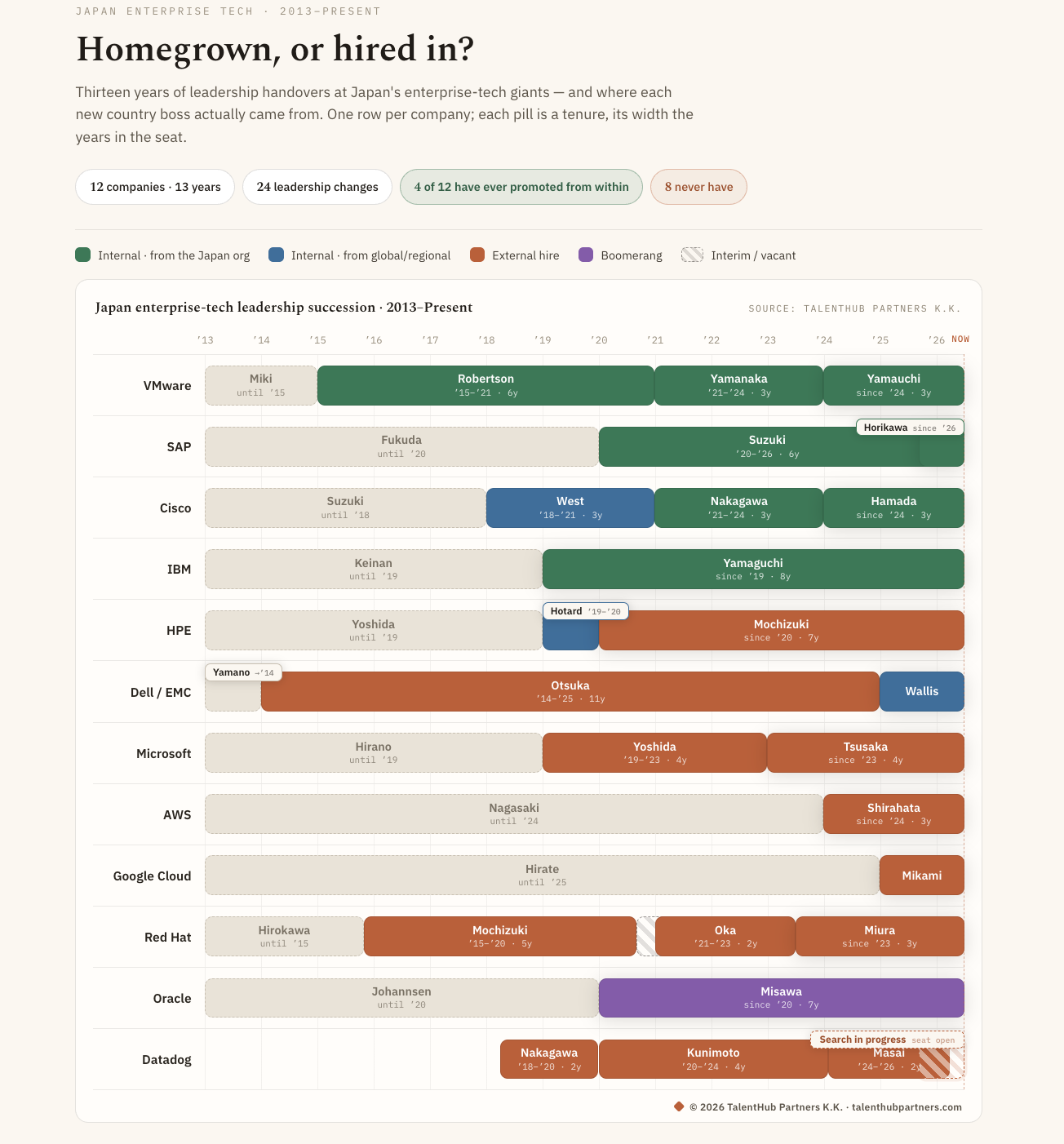
Read down the left of that map and the pattern is not subtle. VMware has done it three times: Miki to Robertson, Robertson to Yamanaka, Yamanaka to Yamauchi, each successor already inside the Japan business. SAP has done it twice, most recently with Horikawa after twelve years in the building. Cisco has done it twice. IBM has done it once, with Yamaguchi, thirty-two years after he joined as an engineer. That is the whole list. Oracle and Dell are the near misses — Misawa returned to Oracle Japan after four years away, and Wallis came from Dell's global organisation with twelve years' service but never a day in the Japan business — and neither is a president grown where they were needed. Microsoft, HPE, Red Hat, AWS, Google Cloud and Datadog have not done it at all.
That is the finding. Succession is not evenly thin across the market. It is concentrated. A small number of companies do it repeatedly, and everybody else does not do it at all.
What it looks like when someone means it
The VMware chain runs Yasuo Miki (2005 to 2015), Jon Robertson (2015 to 2021), Tadashi Yamanaka (2021 to 2024), Hikaru Yamauchi (2024 to now). Four presidents, twenty-one years, and after the first one every successor was already in the building.
Robertson joined VMware Japan in 2007 when the office had about thirty people. Yamanaka joined the same year as an account manager covering financial services. Yamauchi joined in 2010 as a territory manager for manufacturing. Eight, thirteen and fourteen years inside, respectively, before taking the seat.
Two things were said publicly during this period that, read together, explain the whole thing.
The first is Miki-san, in 2015, at the press conference handing the presidency to Robertson. He described VMware Japan as having a Japanese heart and a foreign mindset, said attrition was very low for a foreign firm, and then made a point that is easy to skim past: looking at the division-head level, roughly eighty percent had been grown inside the company, and he intended for that to continue.
A sitting president stating that internal development was deliberate policy, and a number he tracked.
The second is Robertson, in 2021, handing over to Yamanaka. He said he had joined in 2007, spent about fourteen years there, and had always intended to pass the baton to the next generation after five or six years. He described the lineage in family terms: Miki was the grandfather, he was the father, and Yamanaka was the brother.
A president who planned his own exit from the beginning, and said so out loud.
Robertson's record backs it up. He joined with ten staff, grew the organisation past three hundred, kept voluntary attrition under four percent, and was promoted three times in five years on the way up. Low attrition is not a soft metric. It is the precondition for a bench. You cannot promote from within if the people you would have promoted left three years ago.
I watched this from a desk outside the president's office. Miki-san was the elder statesman, superb with customers and partners, the public face of the company. Jon was the engine underneath, the culture builder, the mentor to most of the leaders who came through. The company had both, and it needed both.
The successor everyone could see coming
SAP's chain is Yuzuru Fukuda, then Hirofumi Suzuki (2020 to 2026), then Yoshiro Horikawa (April 2026).
Horikawa's climb is set out in SAP's own announcement. He joined SAP Japan in December 2013, became VP and head of services sales in January 2019, executive officer (常務執行役員) and head of the services division in April 2021, executive officer for cloud success services in April 2022, and executive officer and Chief Business Officer in April 2024, before becoming president on 1 April 2026.
Twelve years inside. Five at executive-officer level. Three functions. Two years in the Chief Business Officer seat as the final proving ground.
Here is the part that matters for anyone in this profession. That succession was legible from outside the company. I could see it. I messaged the man in question at the time, told him he was the obvious next president, and he wrote back and confirmed he was taking the seat.
This required no special insight, which is exactly the point. Anyone paying attention to SAP Japan's executive structure could have drawn the same conclusion. The successor had been placed in a role that only makes sense as preparation, and left there long enough for the market to notice.
Real succession is boring, visible, and surprises nobody. If your succession plan is a surprise, it is not a plan.
Red Hat: the clearest possible admission
Red Hat Japan deserves its own paragraph because it is the purest case in the set.
Hirokazu Mochizuki (2015 to 2020), recruited from Dimension Data Japan. Then a regional SVP holds the seat as interim, because there is nobody to hand it to. Then Genki Oka (2021 to 2023), recruited from Microsoft Japan. Then Miho Miura (2023 to now), recruited from IBM Japan.
Four presidents. Zero internal. Two separate interim periods where the regional executive had to cover the gap.
An interim appointment is the loudest thing a company can say about its own bench. It is an admission, in public, that the seat became vacant and nobody in the building was ready.
Miura describes the process herself. She has said that the successor was not predetermined to come from the IBM group, that the company searched externally for a suitable candidate, and that she did not transfer across from IBM. She resigned and went through the same hiring process as any external candidate.
That is a company with no bench, narrating its own search, on the record.
What the external hires actually cost
Set performance aside. The question is not whether these presidents were good. Several were excellent. The question is what the pattern does to the two hundred senior people below them.
IBM answered this, in print.
When IBM Japan appointed Akio Yamaguchi in 2019, the Japanese press noted he was the first homegrown (生え抜き) Japanese president in seven years, after three consecutive foreign-national leaders. And it named the consequence of that run directly: as the proportion of foreign nationals in executive roles rose, capable Japanese executives had been leaving the company one after another.
That is the mechanism, stated plainly by the business press. Run enough external searches and your bench walks out the door. Then, when you next need a president, you have no bench, so you run another external search.
It is a doom loop, and it is self-reinforcing.
Yamaguchi, incidentally, joined IBM Japan in 1987 as an engineer and reached the president's office thirty-two years later. He is now the incoming representative director (代表幹事) of the Keizai Doyukai, the Japan Association of Corporate Executives.
Datadog, and the runway problem
Datadog Japan is currently searching for a president.
The company has a genuinely strong group of sales leaders. The problem is not talent. It is time. That bench is young, and they have not yet had the four or five years at executive-officer level that a parent company will want to see before handing over a country P&L.
This is not a criticism of Datadog. It is the ordinary condition of a company that scaled fast in Japan over a short period. But it is the most common shape of the problem, and it is worth naming: the bench exists, but nobody started the clock early enough.
Horikawa had five years as an executive officer (常務執行役員) before the seat. Yamauchi had fourteen years in the company. That time cannot be compressed after the incumbent resigns. If you begin building your successor when your president hands in their notice, you are already two years too late, and you are already calling a search firm.
Which brings me to the awkward part.
The carousel, and the people getting off it
Look again at where those external hires came from.
Mochizuki went from IBM Japan to Dimension Data to Red Hat to HPE. Oka went from Microsoft Japan to Red Hat to IBM US. Miura went from IBM Japan to Red Hat. Mikami went from Microsoft Japan to Google Cloud. Otsuka went from IBM to Cisco to Oracle to EMC. Yoshida went from HPE Japan to Microsoft Japan. Misawa went from Oracle Japan to IBM Japan and back to Oracle Japan.
The same forty or fifty executives rotate around the same fifteen companies. Every rotation fills one seat by emptying another. And across sixteen years and twelve companies, the carousel has produced very few presidents who were not already on it.
I should be straight about my own position here. Executive search gets paid when a bench does not exist. That is the commercial reality of the business I am in, and it would be dishonest to write two thousand words about succession without saying so.
But the interesting thing is what is happening at the other end of these careers. Because the people who spent thirty and forty years on that carousel are, increasingly, the ones now trying to build the alternative.
The opportunity: a generation that wants to build the next one
There is a quiet shift underway, and it is coming from the senior end of the market.
Ichiro Nakagawa, who appears in the map above as a president of Cisco Japan, has founded Zero One. Of its three business pillars, the first is next-generation leadership development (次世代リーダー育成), delivered through a programme he calls the Nakagawa Shigaku Juku (中川志学塾), which ran its first session in July. He joined IBM Japan in 1985 and spent roughly forty years in the industry across IBM, HP and Cisco. He has chosen to spend the next part of his career on this. His line is "turn aspiration into reality" (「志を、現実に」).
Hiroshige Sugihara, who opens the Oracle chain in the same map, has built DigitalAid and works on much the same problem from a different angle.
Two of the presidents in this dataset have come off the carousel and started building the thing the dataset shows is missing. They are not alone, and that is the most encouraging finding in this entire exercise.
The other proof that it can be done deliberately is Japan Cloud, which co-manages the Japan entry of foreign SaaS companies. Their model does something the rest of the market treats as too risky: they appoint leaders who are, by the conventional standard, unproven. Then they surround them. Peers running parallel businesses, operating expertise on tap, structured leadership development, and a set of people who have done it before and are on the hook for whether the new leader succeeds.
That is not charity. It is a bet that leadership capability can be built faster inside a support system than it can be bought on the open market, and that the supply of ready-made Japan presidents is too thin to keep bidding for anyway.
The scarcity in this market is not talent. It is the willingness to back someone before they are obviously ready, and then do the work of getting them there.
Which is exactly what Miki-san and Robertson did at VMware, a decade earlier, without calling it a programme.
What global TA and HR should do with this
1. Ask the succession question when you hire the leader, not when they leave.
When appointing a Japan president or an APAC leader, ask them directly: who did you develop into your successor at your last company? Who took over when you left? If the answer is a name, ask what you did to get them ready. If the answer is that the company ran an external search after they departed, that tells you something about the person in front of you.
Nobody asks this in an interview process. It is asked of CEOs by boards, and essentially never asked of country managers by global talent acquisition. Country managers are precisely the people whose departure creates the most expensive vacancy in the region.
2. Make bench depth something the country leader is held to.
Jon (Robertson) owned the numbers for Japan, and he thought constantly about the quality of the team that had to deliver them, year after year. That is the same question as succession, asked in commercial language. Ask your Japan president who could run each of their functions if the incumbent left tomorrow. If they cannot answer, they are not managing succession, and you will find out the hard way.
3. Recognise that succession is a property of the leader, not only the company.
Some leaders leave a functioning organisation and a ready successor behind them at every stop. Others leave a vacancy at every stop. This is visible in the public record across an entire career, and it is remarkably consistent.
Nobody screens for it. Everybody should.
The uncomfortable conclusion
VMware Japan had it good. That is roughly what I said a few weeks ago, when this was still a conversation on a messaging app. What I did not say, and should have, is that "had it good" is not the same as "got lucky."
Jon and Miki-san both thought hard about who would come next, because Jon owned the numbers and knew those numbers depended on the depth of the team standing behind them. Jon arrived intending to hand over within six years, and did exactly that. Yamanaka spent fourteen years earning it.
What looks like fortune from outside was, on inspection, a sequence of deliberate decisions by people who understood that their job included choosing who came next. The kudos belongs to them, Jon in particular. The system they built was not luck at all, and there is no reason it could not be copied.
Eight companies out of twelve have not copied it.
TalentHub Partners is a Tokyo-based executive search firm specialising in country manager and GTM leadership appointments for global technology companies entering and scaling in Japan. This analysis draws on our Japan executive succession database, verified against company announcements and public reporting.
Sources
VMware
- Miki to Robertson handover press conference, 2015: cloud.watch.impress.co.jp
- Robertson to Yamanaka handover press conference, 2021: cloud.watch.impress.co.jp
- Miki Yasuo retirement announcement, May 2020: prtimes.jp
SAP
- New president announcement (Horikawa), March 2026: news.sap.com
- Nikkei xTECH on the transition: xtech.nikkei.com
Cisco
- Executive appointment announcement (Hamada), November 2023: news-blogs.cisco.com
- Nikkei xTECH: xtech.nikkei.com
IBM
- Nikkei, Yamaguchi appointment, April 2019: nikkei.com
- Newswitch / Nikkan Kogyo, on executive attrition during the external run: newswitch.jp
Microsoft
- New management structure (Tsusaka), February 2023: news.microsoft.com
Red Hat
- Mochizuki appointment, November 2015: redhat.com
- Interim president appointment, September 2020: redhat.com
- Miura appointment, June 2023: redhat.com
- Weekly BCN interview, Miura on being hired as an external candidate: weeklybcn.com
- EnterpriseZine interview, on the search process: enterprisezine.jp
HPE
- Nikkei, Mochizuki appointment, September 2020: nikkei.com
Oracle
- Cloud Watch, Misawa return, December 2020: cloud.watch.impress.co.jp
